
Slack
ProductA product discussed on Lenny's Podcast.
4 episodes
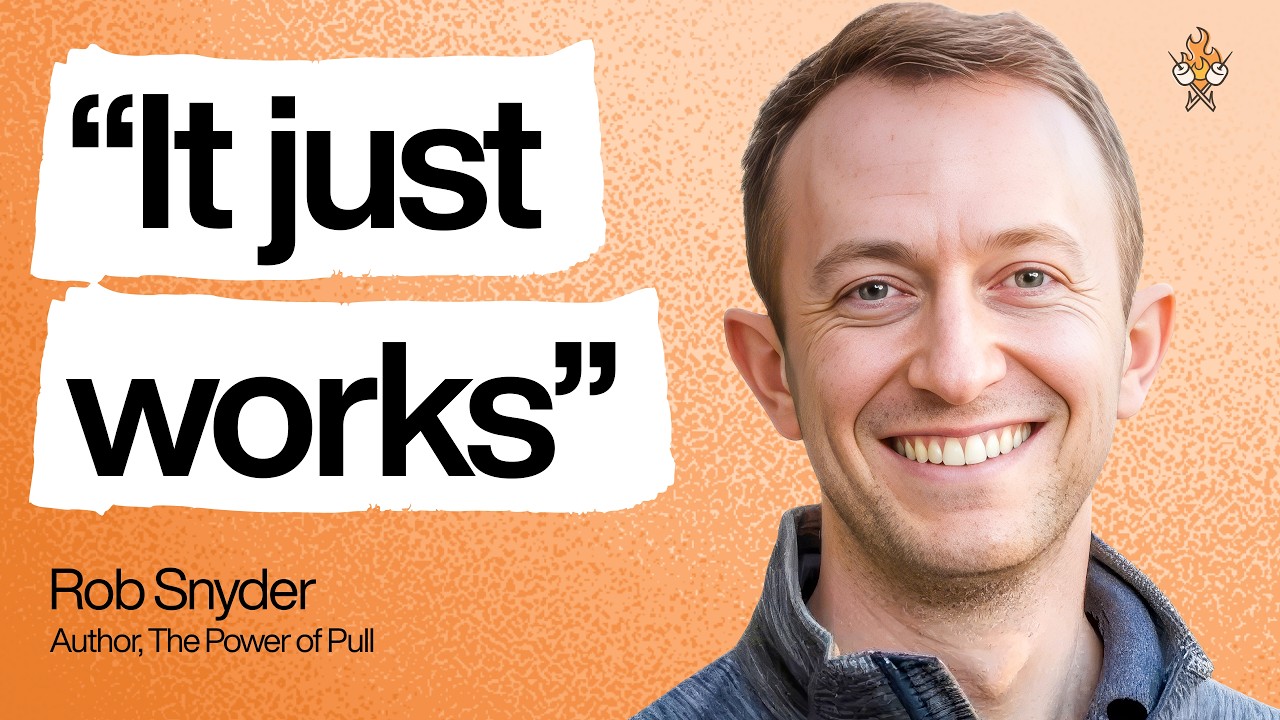
An 86-minute guide to finding PMF | Rob Snyder (Author, The Power of Pull)
Oct 25, 2026 · 1:25:48
On Lenny's Podcast, Rob Snyder, author of The Power of Pull, argues that product-market fit means finding people with PULL—a Project, Unavoidable now, whose List of options have Limitations—who rip the product from your hands. Snyder, who has helped 50+ startups reach $1M ARR, says stake out a PULL hypothesis from firsthand immersion. He recommends founder-magic cold outreach ("Snoop Dogg invested in us"), five-call tests, and cites Jump winning financial advisors who could go to jail without CRM notes. He warns against design partners, pilots, and building first, prescribing the Hail Mary question and goblin mode—Teero's parents door-knocked dental offices. Retention means finding the X after which churn is weird—a startup is a case-study factory repeating one hell-yes customer.

Context is now the product: Product leadership when software can build itself | Karri Saarinen
Sep 29, 2026 · 17:22
Karri Saarinen, co-founder of Linear, argues that AI-driven efficiency alone doesn't produce better products — the learning teams get from doing the work themselves does, and outsourcing execution to agents severs that connection. Drawing on his summer off from following AI news, he says nothing fundamental changed: building great products and growing revenue remains hard. He explains how Linear keeps its learning loop alive — engineers join shared Slack channels with customers, an AI agent sends him daily briefings on customer AI workflows, a weekly Quality Wednesday has everyone find and fix one defect, and optional feature roasts let the whole company critique new features candidly. He urges teams to automate repeatable work and reinvest the saved time in customer context, judgment, and taste, because context becomes the product: better-informed people make better decisions, and hiring for judgment is the first step to building great products.

The rise of HI-ICs | Elena Verna (Lovable)
Sep 28, 2026 · 19:23
Elena Verna, who led growth at Lovable, argues AI has broken the old rule that more reports equal more impact, enabling high-impact individual contributors who can find a problem, decide, execute, ship, and own the outcome alone. She became an IC at Lovable after being fired out of her management role, now spending 90% of her time building—pricing pages, prototypes, analysis—instead of meetings. She calls AI 'average intelligence' at your fingertips, so only one or two areas of exceptional craft are needed. For this to work, organizations must flow information freely (Lovable has no titles, just ICs, leads, and heads, with Slack agents for docs), grant authority with accountability including the right to fail—she has cost Lovable millions in failed experiments—and decouple pay from headcount, arguing ICs should out-earn managers. Her survey found 42 of 51 managers want to return to IC roles; management should be a career choice, not a promotion.

What product looks like when coding is solved | Geoff Charles (Ramp CPO)
Sep 25, 2026 · 19:31
Geoff Charles, CPO of Ramp, argues that building faster with AI is not about coding faster but about finding and removing bottlenecks across the whole product development process. Using an F1 racing analogy—pit stops fell from 67 seconds to 1.8—he shows how Ramp automated each stage: a customer insight agent to surface pain, an agent called Glass to define specs and prototypes, its Inspect coding agent (75% of PRs, 1,000 from non-engineers), ReviewBuddy handling 93% of code reviews, the Testo QA agent that caught 425 bugs in 30 days, and Gadget answering 85% of PM questions. He argues PMs evolve into three tracks—technical factory-builder, tastemaker, and GM—and urges leaders to obsess over the factory, not just the product, using constraints to pick one dimension to be world-class in.
Powered by PodHood